Aunt Wang, 65, had worn reading glasses for over a decade. Recently, to her delight, she discovered something surprising: she could read the newspaper again without her glasses! Before you celebrate such a change, pause. In the clinic, this "sudden improvement in presbyopia" is not uncommon — but it is rarely a miracle. Far more often, it is cataract quietly masquerading as better vision.
Why "Improved" Presbyopia Is Actually a Bad Sign
To understand this, let's look at two concepts:
1. Presbyopia
As we age, the eye's crystalline lens gradually hardens and loses elasticity. Seeing up close — reading a book or a phone — becomes difficult, and reading glasses are needed to compensate.
2. Cataract
A cataract is clouding of that same lens, caused by aging, metabolic disturbances, and other factors, leading to declining vision. Common forms include cortical, nuclear, and posterior subcapsular cataracts.
Now here is the twist. The early presentation of a nuclear cataract is precisely this: the center of the lens becomes denser and its refractive power increases, so the reading glasses that were once needed for near work are no longer required to see clearly up close.
But this is only a brief, "false improvement." As the cataract continues to develop, the lens grows cloudier and vision drops quickly:
- Blurred vision, yellowing of colors, double images
- Harsh, glaring headlights when driving at night, with halos
- Reduced contrast sensitivity — easier to trip and fall while walking
More Than "Better Vision": Other Symptoms to Watch
Beyond this transient presbyopia "improvement," the other classic signs of cataract are often ignored. If any of the following appear, stay alert:
- You needed reading glasses, but lately you can see near objects clearly without them;
- You also have blurred vision, darkened colors, light sensitivity, or glare;
- Night vision drops markedly, or you see rainbow rings around lights.
Please do not ignore these. Come to our ophthalmology outpatient clinic for professional screening. Using slit-lamp microscopy and a vision assessment, the doctor can determine whether a cataract is present and whether surgical intervention is needed.
Not Just Blurry Vision — It Can Blind
Many people think a cataract is merely "a bit unclear." In reality, its dangers are far greater than imagined:
1. Vision keeps declining, toward blindness
The lens clouds a little more each day. From slight blur it can progress to seeing only light and shadow, unable to recognize faces — severely undermining quality of life in later years and raising the risk of falls, bumps, and fractures.
2. Missed chance to treat fundus disease
Many elderly patients also have diabetic retinopathy or macular degeneration. The cataract acts like a pane of frosted glass in front of the eye; the doctor cannot see the fundus clearly, so laser treatment or medication is delayed. By the time the cataract is severe, the fundus disease has become irreversible damage — and even after cataract surgery, vision may not recover well.
3. Greater surgical difficulty and risk
The old idea that a cataract must be "fully ripe" before operating is wrong. In an overripe cataract, the lens nucleus becomes extremely hard, requiring far more ultrasound energy to break it up. The longer you wait, the harder the surgery and the slower the recovery.
4. Risk of blindness
Cataract is the world's leading cause of blindness. Although it is treatable with surgery, if delayed into the overripe stage it can trigger complications such as phacolytic glaucoma and uveitis, which can lead to blindness.
How Is Cataract Treated?
Be clear: no oral medication or eye drops can reverse an already-clouded lens. Surgery is the only scientifically proven treatment for cataract.
Cataract surgery techniques have been continually refined. Femtosecond laser-assisted cataract surgery is one option available in clinical practice today. It uses a femtosecond laser to perform part of the operative steps without a traditional blade. A beam of ultra-short-pulse laser, guided by a computer imaging system, achieves precision down to the micrometer level.
During the procedure, the femtosecond laser can create the corneal incision, complete the capsulotomy (opening of the lens capsule), and pre-fragment the clouded lens. Computer-scanned imaging assists with positioning, making the incision and capsulorhexis smoother and more regular.
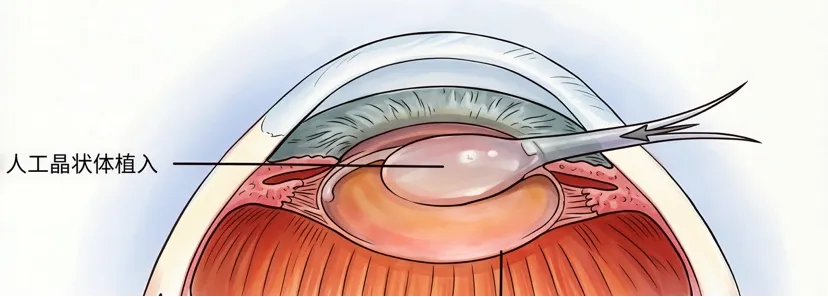
Furthermore, depending on the patient's ocular condition and visual needs, premium intraocular lenses — such as multifocal or extended-depth-of-focus lenses — can be implanted. Different lens types address different refractive ranges, and while treating the cataract they can simultaneously correct myopia, astigmatism, and presbyopia.
Finally, a reminder for everyone: if you notice any abnormality in your vision — whether it "suddenly improves" or "gradually worsens" — do not take it lightly. Visit a professional eye-care institution for a comprehensive eye-health check. Early detection, early diagnosis, and early treatment are what truly protect your clear world. After all, good vision is an essential guarantee of a high-quality life.